Generate TLDR
The Idea
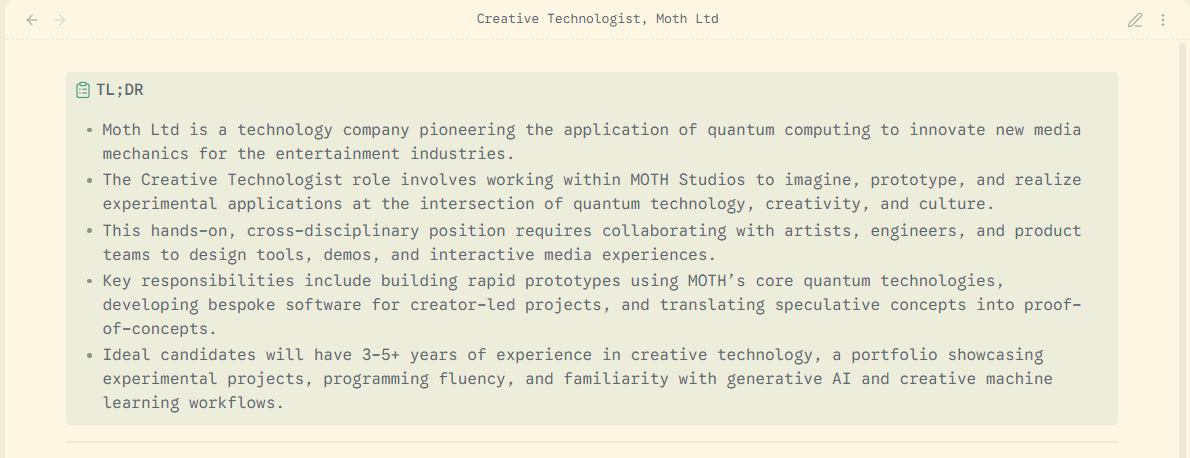
As users' "Second Brains" grow in apps like Obsidian, the sheer volume of information can become overwhelming. The core idea behind Generate-TLDR was to eliminate the "re-reading tax", the time spent scanning long notes to find the main point. I built this plugin to provide a seamless, local-first way to generate executive summaries of Markdown files without leaving the writing environment. Unlike generic web-based summarizers, this tool is designed specifically for the Obsidian ecosystem, respecting the user’s workflow and privacy.
Use Cases
Streamlining Academic ResearchFor researchers and students managing hundreds of lecture notes or paper summaries, the plugin acts as a cognitive filter. By generating a TL;DR at the top of each note, it allows for faster cross-referencing and better information retrieval during the synthesis phase of a literature review.
Meeting & Interview SynthesisIn professional settings, raw transcripts from meetings or user interviews are often too dense to be useful immediately. This tool allows users to transform messy, unstructured transcripts into high-level takeaways and action items, significantly reducing the friction between gathering data and making decisions.
Development
- Plugin Architecture: Built using the Gemini API in TypeScript/JavaScript. The plugin integrates directly into the Obsidian ribbon and command palette, allowing users to trigger summaries with a single hotkey or click.
- AI Implementation: The tool utilizes structured API calls to summarize content while maintaining the original tone and intent of the note. I focused heavily on prompt engineering to ensure the "TL;DR" wasn't just a shorter version of the text, but a synthesized overview of key concepts.
- Beta Distribution: To facilitate early testing and feedback, I leveraged the BRAT (Beta Reviewer's Auto-update Tool) workflow. This allowed me to push updates to users via GitHub releases, bypassing the longer official community plugin review process while the tool is in its iterative beta phase.
Reflection
Building this was a deep dive into the constraints of developing for a specific software ecosystem. It highlighted the importance of "frictionless AI" where the value of the AI is only realized if the user doesn't have to break their flow to use it.
What worked
- Native Integration: The plugin feels like a part of the Obsidian UI, which encouraged more frequent use during my own testing.
- BRAT Deployment: Using BRAT for the beta release was highly effective for rapid iteration and getting the tool into the hands of power users quickly.
Limitations
- Context Windows: Very long files (e.g., 50-page manuscripts) still face token limit challenges in gemini API that require more complex chunking strategies for future updates.
- Dependency: As a beta plugin, users must have BRAT installed, which adds a slight barrier to entry for non-technical users.
Links
GitHub Repository: calluxpore/Generate-TLDR
Install via BRAT: https://github.com/calluxpore/Generate-TLDR